List Of Disabilities That Qualify for ODSP
January 23, 2026

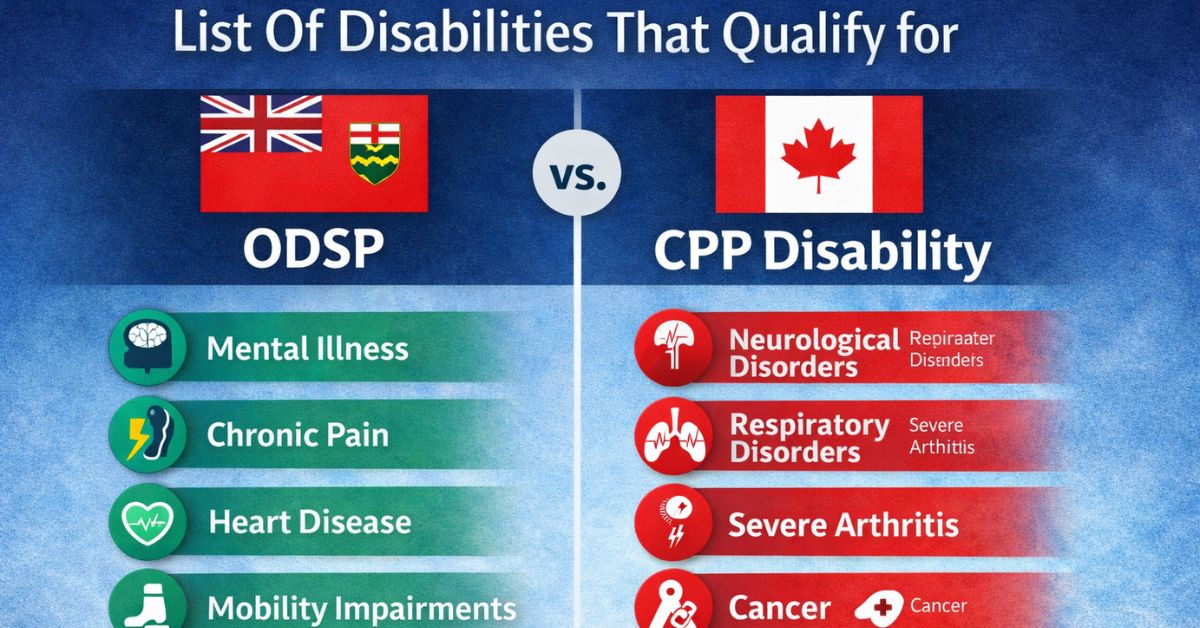
Trying to figure out if your health condition qualifies you for either the Ontario Disability Support Program (ODSP) or the Canada Pension Plan Disability (CPP-D) can feel like a maze. Both programs have their own rules about what counts as a disability. This article breaks down the basics to help you understand the differences and what might apply to your situation. We’ll look at what each program considers a disability and what kinds of conditions are commonly approved. It’s not always straightforward, so let’s get into the details of the list of disabilities that qualify for ODSP versus CPP disability.
Deciding if a disability qualifies for either the Ontario Disability Support Program (ODSP) or the Canada Pension Plan Disability (CPP-D) can feel like a maze. Both programs aim to provide financial help to people who can’t work due to a medical condition, but they have different rules and definitions. Understanding these differences is key to successfully applying for the support you need.
Think of it this way: ODSP is a provincial program specific to Ontario, focusing on financial need alongside disability. CPP-D, on the other hand, is a federal program tied to your work history and contributions to the CPP. This means what might qualify for one might not automatically qualify for the other, even if the medical condition seems similar.
Here’s a quick look at some general differences:
The specific medical conditions that lead to approval can vary widely. It’s not just about having a diagnosis; it’s about how that diagnosis affects your daily functioning and your capacity to earn a living.
This article will break down what each program looks for, common conditions that are often approved, and how your specific situation might fit into their criteria. We’ll try to make it as clear as possible so you can figure out which path might be the right one for you.

So, you’re looking into the Ontario Disability Support Program (ODSP) and wondering what exactly counts as a ‘disability’ in their eyes. It’s not just about having a bad day or a temporary ache. For ODSP, a disability has a pretty specific definition, and it’s all about how it impacts your life long-term.
To even be considered for ODSP as a person with a disability, you generally need to meet a few key points. First off, you’ve got to have a physical or mental impairment. This isn’t just a minor thing; it has to be substantial. Think of it as something that’s always there or keeps coming back, and the doctors expect it to stick around for at least a year.
But it’s not just about the condition itself. The big part is what that condition does to you. ODSP really focuses on the direct and cumulative effect of your impairment on your ability to function. This means they look at whether it significantly limits your capacity to work, to take care of yourself day-to-day, or to participate in your community. It’s about how much it holds you back.
Here’s a breakdown of what they’re looking for:
It’s also worth noting that some specific groups of people might be considered disabled for ODSP purposes without going through the full medical review. These are called ‘prescribed classes,’ and they often relate to people who were receiving certain benefits before a specific date or those who meet certain age and income criteria.
The whole process hinges on proving that your condition isn’t just a diagnosis, but a real, ongoing barrier to your ability to live independently and productively. It’s a high bar, and that’s why getting all your medical documentation in order is so important.
Essentially, ODSP wants to see that your disability is a significant, long-term challenge that makes it hard for you to manage your life without support.
The Canada Pension Plan (CPP) disability benefit is a program that operates nationwide, offering financial support to individuals who can no longer work due to a significant mental or physical impairment. Unlike provincial programs, CPP disability is administered federally, meaning the rules are pretty much the same no matter where you live in Canada, except for Quebec, which has its own parallel system called the Quebec Pension Plan (QPP).
To even be considered, you generally need to have contributed to the CPP for a certain amount of time. This isn’t just about having a condition; it’s about demonstrating that your disability prevents you from doing any kind of work regularly. The key here is ‘substantially gainful employment,’ which basically means a job that pays enough to support yourself.
Here are the main points to keep in mind for CPP disability eligibility:
It’s not just about having a diagnosis. The CPP looks at how your condition affects your ability to work. They want to see medical evidence that backs up your claim. Sometimes, if a condition is particularly severe, it might be fast-tracked. These are often referred to as ‘grave conditions,’ which are serious illnesses with a high probability of meeting the disability criteria. You can find a list of these conditions on the government’s website.
The application process involves detailed medical reports from your doctors. It’s really important to be thorough and provide as much information as possible about how your condition impacts your daily life and your capacity to work. Don’t underestimate the importance of clear, detailed medical documentation.
If you’re earning a certain amount of money from work, it might suggest you’re capable of employment, which could affect your eligibility. For 2026, if you earn more than $20,971.45 (before tax), it’s generally assumed you can work regularly. It’s always a good idea to check the latest contribution requirements for the most up-to-date figures.
Okay, so you’re trying to figure out if your health issue qualifies you for either ODSP (Ontario Disability Support Program) or CPP Disability (Canada Pension Plan Disability). It’s not always a straightforward comparison because these two programs look at ‘disability’ a little differently. Think of it like this: ODSP is provincial, focusing on your situation within Ontario, while CPP Disability is federal, covering all of Canada.
ODSP’s definition is pretty specific. They want to know if you have a physical or mental impairment that’s pretty serious – meaning it’s continuous or keeps coming back, and it’s expected to stick around for at least a year. The big thing for ODSP is that this impairment has to significantly limit your ability to work, take care of yourself, or even just participate in everyday community life. Your doctor or healthcare provider has to confirm this, and they’ll fill out a special package for you. It’s all about the impact on your daily functioning and your capacity for work.
CPP Disability, on the other hand, has a slightly different angle. They’re looking for a “severe and prolonged” disability. This means your condition prevents you from doing any kind of regular, gainful employment. ‘Gainful’ is the keyword here – it means a job that pays enough to support yourself. For 2026, that’s anything over $20,971.45 a year before taxes. So, it’s less about your ability to do your specific job and more about your ability to do any job that pays a decent wage. They also consider if the disability is ‘prolonged,’ meaning it’s expected to last a long time or result in death.
Here’s a quick rundown of the main differences:
It’s also worth noting that ODSP has ‘prescribed classes’ – certain groups of people who automatically meet the disability criteria without going through the full medical review. CPP Disability doesn’t really have an equivalent to this, though certain severe conditions might get fast-tracked.
The medical evidence you provide is key for both. You’ll need detailed reports from your doctors, specialists, and any other healthcare professionals who have treated you. The more thorough and consistent the information, the better your chances of getting approved for either program. It’s not just about having a diagnosis; it’s about showing how that diagnosis affects your life and your ability to earn a living.
So, while there’s definitely overlap in the types of conditions that might qualify for both, the way they define ‘disability’ and the specific criteria they use can lead to different outcomes for applicants. It really comes down to the details of your medical condition and how it impacts your life according to each program’s rules.

So, what exactly counts as a disability when you’re trying to get help through Ontario’s ODSP program? It’s not just about having a bad day or a temporary ache. ODSP has a pretty specific definition they work with.
First off, you need to have a physical or mental impairment. This isn’t something that just popped up yesterday and will be gone next week. It has to be something that’s continuous or keeps coming back, and doctors expect it to stick around for at least a year. Think of it like a persistent condition, not a fleeting one.
Then, there’s the impact. It’s not enough to just have the condition. ODSP wants to know how it affects your life. Does it seriously limit your ability to work? Can you not manage to take care of yourself properly? Or does it make it really hard to get out and be part of the community? They look at the direct effects of your impairment, and also how all those little things add up over time. It’s about the substantial restriction it causes.
Finally, you need proof. You can’t just tell them you have a disability. You need a qualified health care professional – like a doctor or a specialist – to verify your condition, how long they think it will last, and the restrictions it causes. They’ll fill out a special package for you to send in.
Here’s a quick rundown of the main points:
It’s a pretty thorough process, and they really want to make sure the support goes to people who genuinely need it because of a long-term disability.
So, what exactly counts as a disability when you’re looking at the Canada Pension Plan (CPP) Disability benefits? It’s not just about having a bad day or a temporary injury. The CPP looks for something pretty serious: a medical condition that is severe and prolonged. This means it has to be so bad that it stops you from doing any kind of regular work, and it’s expected to last for a long time, or likely result in death.
Think about it this way: it’s not just about the diagnosis itself, but how that diagnosis impacts your ability to earn a living. They want to see that your condition prevents you from doing substantially gainful employment. What’s ‘substantially gainful’? Well, for 2026, that’s defined as earning more than $20,971.45 before taxes. If you’re earning less than that, it might not affect your benefits, but earning more could suggest you’re capable of regular work.
Here’s a breakdown of the core ideas:
Sometimes, if a condition is particularly bad, it might be considered a ‘grave condition.’ These are usually rapidly progressing illnesses that have a high chance of meeting the disability criteria. The government has a list of conditions that are often fast-tracked because they are known to be severe and life-limiting. Examples include certain aggressive cancers, ALS, and advanced stages of diseases like kidney or liver failure.
The key is that the disability must prevent you from earning a living through regular employment. It’s a high bar, and they look at the whole picture, not just one symptom or diagnosis. Medical evidence is super important here.
It’s also worth noting that if you have a terminal illness, meaning a disease that can’t be cured and is likely to cause death within six months, that definitely qualifies as a severe and prolonged disability under the CPP rules.
When you’re looking at qualifying for ODSP, physical conditions are a big part of the picture. It’s not just about having a diagnosis, though. The program really focuses on how that condition impacts your day-to-day life and your ability to work or participate in the community. They want to see that the impairment is substantial, meaning it really gets in the way, and that it’s expected to stick around for at least a year.
Some common physical conditions that often lead to ODSP approval include:
It’s important to remember that the severity and the specific way these conditions affect you are key. For example, someone with mild arthritis might not qualify, but if it severely limits their ability to stand or walk for extended periods, it could be a different story. The medical professional filling out your application needs to clearly explain these limitations.
The core idea is that the physical condition creates a significant, ongoing barrier to your ability to function independently or hold down a job. It’s about the functional impact, not just the name of the illness itself. This is why detailed medical evidence is so important.
Here’s a general idea of how some conditions might be viewed, though each case is unique:
| Condition Category | Examples | Potential Impact on Function |
| Musculoskeletal | Severe Osteoarthritis, Spinal Cord Injury | Difficulty with mobility, standing, lifting, and fine motor skills |
| Cardiovascular/Respiratory | Congestive Heart Failure, COPD | Limited stamina, shortness of breath, inability to perform physical tasks |
| Neurological | Stroke, Epilepsy | Impaired motor control, cognitive issues, seizures, and balance problems |
| Chronic Pain | Fibromyalgia, Chronic Back Pain | Fatigue, inability to concentrate, limited physical activity tolerance |

When it comes to mental health, ODSP looks at how a condition impacts your daily life and ability to function. It’s not just about having a diagnosis; it’s about the substantial restrictions it creates.
Many mental health conditions can qualify if they meet the program’s criteria. This means the condition is continuous or comes back often, is expected to last at least a year, and significantly affects your capacity to work, manage self-care, or engage with the community. A healthcare professional needs to verify this.
Some common mental health conditions that individuals apply for ODSP with include:
It’s important to remember that the specific diagnosis is only part of the picture. The severity of the symptoms and how they interfere with your life are what really matter for ODSP eligibility. For instance, someone with mild depression might not qualify, but someone whose depression is severe and prevents them from working or leaving their home likely would.
The key is demonstrating a substantial and ongoing limitation. This isn’t a temporary setback; it’s a condition that has a long-term, significant effect on your ability to manage everyday tasks and responsibilities.
Think about how your mental health condition affects things like:
Gathering thorough documentation from your psychiatrist, psychologist, or other treating mental health professionals is absolutely vital. This documentation should detail your diagnosis, treatment history, current symptoms, and, most importantly, the functional limitations caused by your condition.
When we talk about developmental and neurological conditions, ODSP looks at how these conditions affect a person’s day-to-day life. It’s not just about having a diagnosis; it’s about the impact it has on your ability to work, manage personal care, or participate in community activities.
Some common developmental and neurological conditions that might qualify include:
The key is whether the condition causes a substantial restriction in your ability to perform essential daily functions. This means the condition needs to be ongoing, or likely to recur, and expected to last at least a year. It’s also important that a qualified healthcare professional has verified the impairment and its effects.
Think about conditions like ADHD, learning disabilities, or even conditions that develop later in life, like dementia. The severity and how it limits your life are what ODSP really focuses on. They want to see that the condition significantly interferes with your capacity to function independently or hold down a job. It’s a pretty thorough process, and having detailed medical reports is a big part of it. If you’re looking for more information on how the Ontario Disability Support Program works, you can check out ODSP financial assistance.
The medical assessment for ODSP is quite detailed. It requires a healthcare professional to confirm not only the diagnosis but also the continuous or recurrent nature of the impairment and its expected duration. They also need to document the cumulative effect of the impairment on your ability to work, care for yourself, and engage with the community.
It’s also worth noting that some conditions might not be immediately obvious but can still qualify if they meet the program’s criteria. For instance, a severe learning disability or a chronic neurological issue that significantly impacts cognitive function could be grounds for eligibility. The focus remains on the functional limitations caused by the condition, rather than the condition itself.
Sometimes, a disability doesn’t fit neatly into the standard categories. For the Ontario Disability Support Program (ODSP), this means certain conditions might be evaluated individually. The key is whether the condition significantly impacts your ability to work, care for yourself, or participate in community life, and if it’s expected to last at least a year. It’s not just about having a diagnosis; it’s about the real-world effects of that diagnosis.
When ODSP reviews these cases, they look at a few things:
It’s a bit like putting together a puzzle. Each piece of medical information, combined with your personal account of how the disability affects you, helps build the full picture for the adjudicators.
The process for these case-by-case situations often involves a detailed Disability Determination Package. This package requires input from you and your healthcare providers, outlining the nature of your condition and its effects on your daily functioning. It’s important to be thorough and provide as much relevant information as possible.
Some conditions that might fall into this category include:
Remember, this list of disabilities that qualify for ODSP isn’t exhaustive. Each application is unique, and the program aims to assess each person’s situation fairly. Having a solid list of disabilities that qualify for ODSP is helpful, but understanding the individual assessment process is just as important for those with less common conditions.
When you’re applying for Canada Pension Plan (CPP) Disability benefits, the focus is on how a medical condition stops you from doing any regular, continuous work. It’s not just about having a diagnosis; it’s about the impact that diagnosis has on your ability to earn a living. Some conditions are more commonly approved because their disabling effects are well-understood and often severe.
Think about progressive conditions, meaning they get worse over time, or those that have a significant and lasting impact on your physical or mental capacity. Here are some examples of conditions that frequently lead to CPP Disability approval:
It’s important to remember that even with these conditions, the approval hinges on demonstrating that your specific situation prevents you from doing any regular, continuous employment. The severity and the impact on your daily life and work capacity are key.
The medical review board looks at the whole picture. They want to see that you’ve tried to manage your condition, that you’re following medical advice, and that despite these efforts, your disability still prevents you from working. It’s about the functional limitations, not just the diagnosis itself.
When you apply for Canada Pension Plan (CPP) Disability benefits, some conditions are recognized as being so severe that they can speed up the application process. These are often referred to as “grave conditions.” Basically, these are rapidly progressing medical issues that have a high chance of meeting the disability criteria. Think of it as Service Canada acknowledging that for certain illnesses, the need for support is immediate and the prognosis is quite serious.
The idea behind fast-tracking grave conditions is to get financial help to individuals who are unlikely to recover and whose conditions are expected to lead to death within a relatively short timeframe.
While there isn’t a single, exhaustive list that covers every single possibility, the government has identified certain conditions that typically fall into this category. These often include aggressive forms of cancer, advanced neurological diseases, and other life-threatening illnesses.
Here are some examples of conditions that are often considered grave:
It’s important to remember that even with a grave condition, you still need to meet the general eligibility requirements for CPP Disability, which include having contributed to the CPP and having a disability that is both severe and prolonged. However, having a condition recognized as grave can significantly simplify the medical assessment part of your application.
The medical review process for CPP Disability aims to assess the severity and impact of your condition. For grave conditions, the progressive nature and poor prognosis are key factors that often lead to a quicker assessment and approval, assuming other eligibility criteria are met.
It’s pretty common for people with serious health issues to wonder if their condition might qualify for both the Ontario Disability Support Program (ODSP) and the Canada Pension Plan Disability (CPP-D) benefits. The good news is that many conditions can indeed meet the criteria for both programs. This often happens when a disability is severe, long-term, and significantly impacts your ability to work and manage daily life.
Think about conditions like severe chronic pain, advanced multiple sclerosis, debilitating mental health disorders like severe depression or schizophrenia, or significant physical injuries from accidents. These aren’t usually clear-cut cases where one program says yes and the other says no. Instead, they often fall into a grey area where the severity and impact are the main deciding factors.
Here’s a general idea of how conditions might overlap:
The main thing to remember is that both ODSP and CPP-D look at the impact of your condition. It’s not just the diagnosis itself, but how that diagnosis affects your ability to perform regular, continuous work and manage your day-to-day life. Having a doctor’s detailed report that clearly outlines these limitations is super important for both applications.
Applying for both can sometimes be a good strategy, as they have different application processes and decision-makers. If one application is denied, the other might still be approved. It’s worth exploring if your condition fits the criteria for both, as this could provide a more stable financial future.
When you’re applying for either ODSP or CPP Disability, it’s not just about having a diagnosis. The big question for both programs is how severe your condition is and what that means for your day-to-day life. They really want to know if your disability stops you from doing regular work.
For ODSP, they look at your medical condition and how it affects your ability to do basic activities. Think about things like:
The more these daily tasks are impacted, the stronger your case is likely to be.
CPP Disability has a similar focus, but it’s more about your ability to do any substantially gainful employment. They consider your medical condition, its severity, and how long it’s expected to last. They also look at your age, education, and work history to figure out if you can adapt to a different kind of job. If your condition is considered “grave” or “terminal,” it can significantly speed up the approval process because the severity is often obvious.
It’s important to remember that even with a serious diagnosis, if you can still manage to work part-time or do certain jobs, you might not qualify. The bar is set pretty high for proving you can’t work at all.
Here’s a simplified look at what they might consider:
| Factor | ODSP Focus | CPP Disability Focus |
| Medical Condition | Diagnosis and its impact on daily activities | Diagnosis, severity, and expected duration |
| Functional Impact | Ability to perform basic life activities | Ability to perform any substantially gainful employment |
| Work Capacity | Ability to do regular, full-time employment | Ability to do any type of work, considering all factors |
| Severity | How much does it limit daily functioning | How much it limits work capacity; “grave” or “terminal.” |
Basically, you need to show that your disability isn’t just a minor inconvenience; it’s a major barrier to living independently and earning a living.
Okay, so you’re looking into ODSP or CPP Disability, and you’re wondering what kind of paperwork you actually need to get this done. It can feel like a lot, honestly. Both programs want to see proof that you meet their specific rules for disability, and they go about it a little differently.
For ODSP, the big thing is the Disability Determination Package. Your caseworker will hand this over, and it’s basically a detailed report for you and your doctor(s) to fill out. You’ve got 90 days to get it back to them, so don’t let it sit around too long. This package is where you explain how your condition stops you from working, taking care of yourself, or being part of the community. It needs to be verified by a healthcare professional, which is a key step. They’re looking for a substantial mental or physical impairment that’s expected to stick around for at least a year.
The core of your application hinges on clearly showing the impact of your disability. It’s not just about having a diagnosis; it’s about demonstrating how that diagnosis significantly limits your daily life and ability to function.
CPP Disability has its own forms, and it’s really important to work closely with your doctor on these. They’ll need to provide detailed medical information about your condition. If you have a terminal illness, there are specific options to select on the application. The goal here is to prove your condition is severe and prolonged, meaning it prevents you from doing any regular employment and is likely to result in death or has lasted, or will likely last, for at least three years.
Here’s a quick look at what you’ll generally need:
It’s also a good idea to gather any other supporting documents you might have, like specialist reports, therapy notes, or even a personal statement detailing how your disability affects you. The more complete and clear your evidence is, the smoother the process tends to be.

Getting approved for ODSP or CPP Disability can feel like a marathon, not a sprint. You want to make sure you’re putting your best foot forward, and that means having all your ducks in a row. It’s not just about having a condition; it’s about showing how that condition really messes with your ability to live your life and work.
First off, be super thorough with your medical information. This isn’t the time to be shy or hold back. Make sure your doctors know you’re applying and that they fill out all the forms completely. They need to detail your diagnosis, how long it’s been going on, and what treatments you’ve tried. The more detailed and consistent the medical evidence, the better. Think about getting reports from specialists if you have them – they often have more specific insights.
Here are some things to focus on:
Sometimes, the application process can feel overwhelming, and it’s easy to get discouraged. Remember that you have the right to ask questions and seek clarification. Don’t hesitate to reach out to the ODSP office or Service Canada if you’re unsure about something. It’s better to ask than to make a mistake that could delay your claim.
So, you’ve been looking into disability benefits and trying to figure out which list of conditions applies to you, ODSP or CPP. It can feel like a maze, right? Both programs have their own ideas about what counts as a disability, and honestly, it’s not always straightforward.
The biggest thing to remember is that neither program has a simple, fixed list of every single condition that automatically qualifies. Instead, they look at how your specific health issue impacts your ability to function.
Here’s a quick breakdown of what to keep in mind:
Think of it like this:
While specific conditions might be more commonly approved, the approval hinges on the individual’s unique circumstances and the documented impact of their health issue on their capacity for work and daily living. It’s a personalized assessment, not a simple checklist.
Sometimes, a condition might qualify for one program but not the other, or it might qualify for both. It really depends on the specifics of your situation and how well you can present your case with supporting documentation. If you’re unsure, it’s always best to get advice from someone who understands the ins and outs of both ODSP and CPP disability applications.
Understanding which disabilities qualify for ODSP versus CPP Disability can be confusing. It’s important to know the differences to make sure you’re applying for the right support. If you need help figuring out the details, visit our website for clear explanations and guidance.
Think of ODSP (Ontario Disability Support Program) as a provincial program just for people in Ontario. CPP Disability (Canada Pension Plan Disability) is a national program that’s part of your Canada Pension Plan contributions. They both help people with disabilities, but they have different rules for who gets approved.
ODSP looks at whether your disability is ‘substantial.’ This means it seriously limits your ability to do everyday things like work, take care of yourself, or be part of your community. It also has to be expected to last for at least a year or be ongoing. It’s not just about having a diagnosis; it’s about how that condition affects your life.
CPP Disability focuses on whether your medical condition stops you from doing any job or any type of work regularly. They often approve conditions that are very serious and long-lasting, like severe heart disease, cancer, or major physical injuries that prevent you from working.
Yes, absolutely. ODSP considers mental health conditions just like physical ones. If your mental health issue is severe, continuous, or comes back often, and makes it hard for you to work or manage daily life, you might qualify.
Sometimes, people can be part of ‘prescribed classes,’ which means they don’t have to go through the usual disability review. This can include people who were on certain benefits before, or those who are already getting specific disability pensions. It’s not about a specific diagnosis but about your situation.
A ‘grave condition’ for CPP Disability means your medical issue is so severe that it’s expected to result in death. If your condition is considered grave, your application might be processed faster because the need is very urgent.
Yes, definitely. For both ODSP and CPP Disability, you’ll need detailed reports from your doctor or other health professionals. They need to explain your condition, how it affects you, and why you can’t work or manage daily tasks. This medical proof is super important.
You can apply for both programs separately. Many people do because they are different systems. If you get approved for both, you’ll receive benefits from each, but they might affect each other, so it’s good to understand how they work together.
ODSP generally requires the disability to be continuous or recurrent and expected to last for at least one year. CPP Disability also looks for a long-term inability to work. If your condition is temporary, it might be harder to qualify for either program.
CPP Disability’s main question is whether your medical condition prevents you from doing any regular job. They look at whether your condition is ‘seriously debilitating’ and stops you from earning a living. It’s not just about your usual job, but any job you could reasonably do.
For ODSP, you’ll get a Disability Determination Package. You and your doctor need to fill this out completely. It asks about your medical condition, how it affects your daily life, and your ability to work. You have 90 days to return it.
Yes, both programs can offer additional benefits. ODSP, for example, provides health benefits like drug coverage, dental care, and help with assistive devices. CPP Disability is primarily a monthly payment, but some provinces might have related benefits.