VFV vs VOO
January 17, 2026

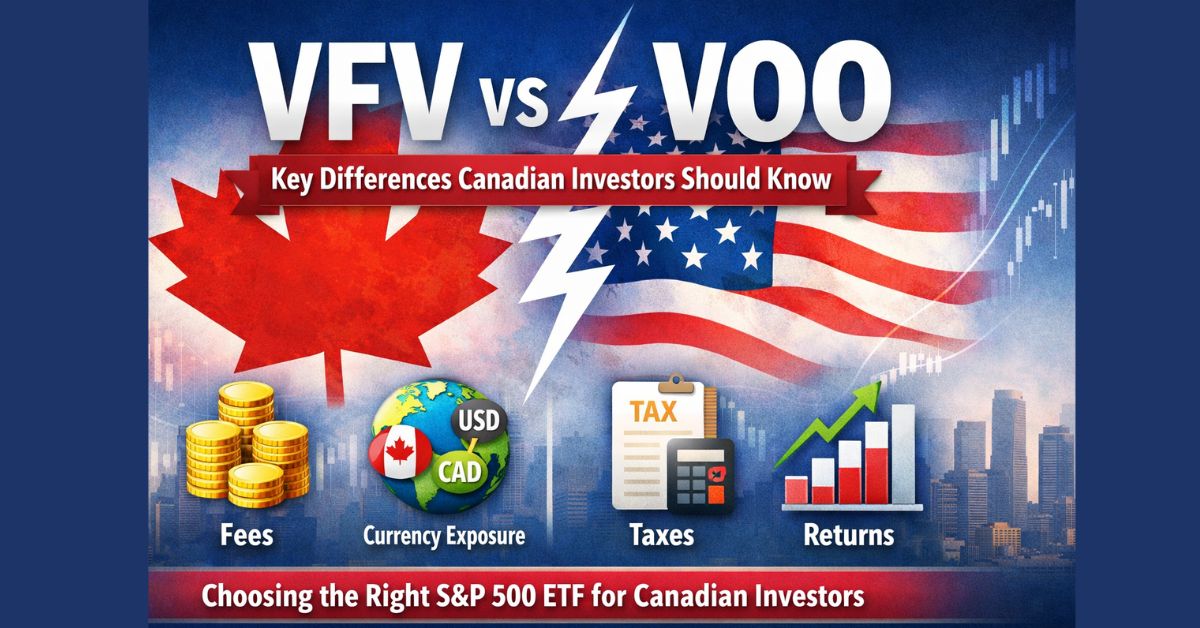
Deciding between VFV and VOO for your investments can feel a bit confusing, especially when you’re a Canadian investor. Both ETFs aim to track the S&P 500, which is a big deal in the stock market. But they aren’t the same. There are some important differences in how they’re set up, the currency they use, and how taxes work. Let’s break down these vfv vs voo distinctions so you can make a smarter choice for your money.
So, you’re looking at investing in the S&P 500, and you’ve probably come across two ETFs: VFV and VOO. It’s a common question for Canadians – which one is the better pick? Both aim to do the same thing: track the performance of the 500 largest U.S. companies. But, as you might expect, some key differences can actually matter quite a bit for your portfolio, especially if you’re investing from up here in Canada.
Think of it like this: VFV is basically Vanguard’s Canadian-domiciled version of the U.S.-based VOO. They both follow the same index, the S&P 500, which is a big deal in the investment world. However, the way they’re structured, where they trade, and how they handle things like currency and taxes can lead to different outcomes for your returns.
Here’s a quick look at what we’ll cover:
Understanding these points will help you figure out which ETF aligns better with your investment strategy and your specific accounts, like your TFSA or RRSP. It’s not just about picking the “best” ETF, but the best ETF for you.
The choice between VFV and VOO isn’t always straightforward. While they track the same index, the mechanics of how they operate from a Canadian investor’s perspective introduce variables that can affect your net returns over the long haul. It’s worth digging into these details before you commit your capital.
So, you’re looking at investing in the U.S. market, specifically the S&P 500, but you want to do it from Canada. That’s where VFV comes in. VFV is Vanguard’s S&P 500 Index ETF that trades right here on Canadian exchanges, like the TSX, and it’s all priced in Canadian dollars. Think of it as your easy-access ticket to the 500 biggest companies in the United States, without having to deal with U.S. currency directly when you buy it.
It’s managed by Vanguard Investments Canada Inc., and its main goal is to follow the S&P 500 index as closely as possible. This means it holds the same kinds of companies you’d find in the S&P 500, in roughly the same proportions.
Here’s a quick look at what VFV offers:
For Canadian investors, VFV provides a straightforward way to get exposure to the U.S. stock market. It simplifies the process by handling the currency conversion for you on the buy side and is listed on a familiar exchange.
It’s designed for investors who want the broad diversification of the S&P 500 but prefer to keep their investments in Canadian dollars and trade on a Canadian platform. This can make it feel a bit more familiar and less complicated than buying a U.S.-listed ETF directly.
Alright, let’s talk about VOO. This is the U.S.-domiciled version of an S&P 500 index ETF, managed by Vanguard. Think of it as the original blueprint for tracking the performance of the 500 largest publicly traded companies in the United States. It’s a really popular choice for investors who want broad exposure to the U.S. stock market without picking individual stocks.
VOO aims to replicate the S&P 500 Index as closely as possible. This means it holds the actual stocks that make up the index, in roughly the same proportions. It’s a straightforward way to invest in a huge chunk of the American economy.
Here’s a quick look at some key details:
The S&P 500 itself is widely considered a benchmark for the overall health and performance of the U.S. stock market. When VOO does well, it generally means the big U.S. companies are doing well.
For Canadian investors, holding VOO directly means you’ll be dealing in U.S. dollars and will need to consider currency exchange. It also has implications for how dividends are taxed, which we’ll get into later. But for now, just know that VOO is a solid, low-cost way to get your hands on the performance of the S&P 500 Index right from the source.

So, VFV and VOO. Both are designed to give you a piece of the S&P 500, which is basically a snapshot of the 500 biggest companies in the U.S. stock market. Think of it like buying a basket that holds stocks from companies like Apple, Microsoft, and Amazon, all in one go. This is a pretty standard way to invest if you don’t want to pick individual stocks.
Here’s the basic idea:
The core mechanism for both is to replicate the performance of the S&P 500.
While they aim for the same target, how they get there is where things start to differ, which we’ll get into more. But for now, know that the goal is identical: to mirror the S&P 500’s ups and downs. This approach is a popular choice for many investors looking for broad market exposure, and you can find more details on comparing these S&P 500 ETFs.
It’s important to remember that while the index is the same, the way the ETFs are structured and where they trade can lead to subtle differences in how you experience their performance, especially when you factor in things like currency and taxes.
So, what’s the big deal with how VFV and VOO are put together? It’s actually pretty straightforward, but it matters for us Canadians. When you buy VOO, you’re buying directly into the U.S. S&P 500 ETF. It holds all those big American companies. Simple enough, right?
Now, VFV is a bit different. Think of VFV as a Canadian wrapper around the U.S. ETF, VOO. Instead of Vanguard Canada buying all those individual U.S. stocks directly, they actually buy shares of VOO. So, when you invest in VFV, you’re indirectly owning the S&P 500 companies because VFV owns VOO, which in turn owns the stocks.
Here’s a quick breakdown of that structure:
This setup is the main reason for some of the other differences we’ll talk about, like taxes and how currency plays a role in vfv vs voo. It’s a key point to grasp when comparing VFV vs VOO, and understanding this VFV vs VOO relationship helps clarify why VOO vs VVF might behave slightly differently for you.
The way VFV is structured to hold VOO is a clever way for Vanguard to offer a Canadian-domiciled S&P 500 ETF. It simplifies things for Canadian investors who want exposure to the U.S. market without having to deal with opening a U.S. brokerage account directly, but it does introduce some nuances, especially around taxes and currency, when comparing vfv vs voo.
Okay, so let’s talk about the money stuff – the currency differences between VFV and VOO. This is where things can get a little tricky for us Canadians.
When you buy VFV, you’re buying an ETF listed on a Canadian exchange, and it’s priced in Canadian dollars (CAD). Simple enough, right? But here’s the catch: VFV actually holds another ETF, which is VOO. And VOO is listed on a U.S. exchange and priced in U.S. dollars (USD).
So, even though you’re buying VFV with CAD, the value of your investment is ultimately tied to how the U.S. dollar is doing compared to the Canadian dollar. This means the exchange rate between USD and CAD can directly impact your returns, even if the S&P 500 index itself isn’t moving much.
If the U.S. dollar gets stronger compared to the Canadian dollar, your VFV investment will likely see a boost in its CAD value, all else being equal. On the flip side, if the Canadian dollar strengthens, your VFV investment’s value in CAD will take a hit.
Now, if you decide to buy VOO directly, you’ll need to convert your Canadian dollars into U.S. dollars first. This means you’re dealing with the exchange rate right from the start. Your investment in VOO is in USD, but when you eventually want to bring that money back into CAD, the exchange rate will play a role again.
Here’s a quick rundown:
It might seem like there’s a difference in how currency affects them, but really, if you’re holding VFV, you’re exposed to the same currency risk as if you bought VOO and then converted it back to CAD. It’s just packaged differently.
The key takeaway here is that neither VFV nor VOO is inherently ‘currency-hedged’ in a way that eliminates exchange rate risk for a Canadian investor. You’re always going to be subject to how the USD/CAD pair moves, whether you buy the Canadian version or the U.S. version and do the currency conversion yourself.
When you’re looking at ETFs like VFV and VOO, one of the first things that jumps out is the cost, specifically the Management Expense Ratio, or MER. Think of it as a small annual fee you pay to the fund manager for keeping everything running smoothly. It might seem tiny, but over a long time, these small percentages can really add up.
Here’s a quick look at the MERs:
VOO has a significantly lower MER than VFV. This difference might not seem like much on paper, but it’s a key distinction for Canadian investors. A lower MER means more of your investment returns stay in your pocket, rather than going to the fund manager. For example, if you have $10,000 invested, VFV’s MER would cost you $9 per year, while VOO’s MER would only cost $3. It’s not a huge difference initially, but imagine that on $100,000 or over 20 years.
This cost difference is partly because VOO is a much larger fund with more assets under management. Generally, bigger funds can spread their operating costs over a larger base, leading to lower expense ratios. VFV, being the Canadian-domiciled version that holds VOO, has a slightly higher fee structure.
While both MERs are considered low in the grand scheme of investing, the difference between 0.09% and 0.03% is substantial enough to warrant attention, especially for investors focused on minimizing costs over the long haul. It’s a good reminder to always check the MER when comparing ETFs, even if they track the same index.
For many investors, the slightly higher MER of VFV is a trade-off for the convenience of trading in Canadian dollars and avoiding some of the complexities of holding a U.S.-listed ETF. However, if cost minimization is your absolute top priority, VOO’s lower MER is certainly attractive. You can find more details on Vanguard S&P 500 ETF options on their website.

When you’re looking at ETFs like VFV and VOO, those small differences in fees can really add up over time. It’s not just about the sticker price; it’s about what that tiny percentage eats away from your investment gains year after year. Think of it like a slow leak in a tire – it might not seem like much at first, but eventually, it’ll leave you stranded.
Let’s break down the main cost difference:
Here’s a quick look at the MERs:
| ETF | MER |
| VFV | 0.09% |
| VOO | 0.03% |
So, how does this play out? Imagine you invest $10,000. With VOO’s lower MER, you’re keeping more of your money working for you. Over 30 years, that 0.06% difference (0.09% – 0.03%) can mean thousands of dollars more in your pocket. It’s why Vanguard itself points to these low fees as a reason to consider these S&P 500 ETFs for the long haul.
The impact of fees isn’t always obvious in the short term. It’s a compounding effect, working both for you (if you minimize fees) and against you (if you pay high fees). Small differences in annual expenses can lead to significantly different portfolio values over many years, especially when comparing ETFs that track the same index.
Ultimately, while both ETFs offer a way to invest in the S&P 500, the lower fees associated with VOO can provide a slight edge in long-term returns, assuming you manage any associated currency conversion costs effectively.
Okay, let’s talk about something that can chip away at your returns without you even noticing: dividend withholding tax. When you hold U.S. stocks or ETFs that pay dividends, Uncle Sam likes to take a small cut before the money even gets to you. For Canadian investors, this usually means a 15% tax on those dividends.
Here’s the lowdown:
| Account Type | Holding VOO Directly | Holding VFV | Notes |
| TFSA | 15% Withholding Tax | 15% Withholding Tax | Tax is applied before it reaches your account. |
| RRSP | 0% Withholding Tax | 15% Withholding Tax | Tax treaty benefit applies to direct VOO holdings. |
| Taxable Account | 15% Withholding Tax | 15% Withholding Tax | Foreign tax credit may be claimable on your Canadian tax return for VOO. |
The key takeaway here is that if your goal is to completely avoid the U.S. dividend withholding tax, holding VOO directly within your RRSP is your best bet. For other account types, both VFV and VOO (held directly) will incur that 15% tax on dividends. It’s not the end of the world, especially if you can claim a foreign tax credit, but it’s definitely something to be aware of when comparing these two ETFs. The Tax-Free Savings Account (TFSA) in Canada has its own nuances regarding foreign withholding tax, so understanding how it applies is important for all your investments.
When you’re looking at VFV versus VOO, taxes can really make a difference, especially depending on where you hold them. It’s not just about the investment’s performance, but also about what you keep after taxes.
The big win for holding VOO in an RRSP is avoiding the U.S. dividend withholding tax. Normally, dividends paid by U.S. companies to non-U.S. investors get hit with a 15% tax. Since VFV is a Canadian ETF that actually holds VOO (or similar U.S. ETFs), this tax gets applied before the dividends even reach you. So, even though VFV is in your Canadian account, that 15% tax still bites.
However, because of a tax treaty between Canada and the U.S., holding VOO directly within your RRSP means those dividends are exempt from that 15% withholding tax. This is a pretty sweet deal because it means more of the dividend income stays in your account, compounding over time.
Here’s a quick look at how it plays out:
So, if your main goal is to maximize dividend income and minimize tax drag within a retirement savings plan, holding VOO directly in your RRSP is the way to go. For other accounts like a TFSA or a regular taxable account, the difference between VFV and VOO regarding this specific tax might be less impactful, or VFV might be simpler to manage.
It might seem like a small percentage, but over many years, that 15% tax can really add up, chipping away at your potential returns. It’s one of those details that can make a noticeable difference in your long-term investment growth.
When we look at how VFV and VOO have performed over time, it’s pretty interesting. Since they both aim to mirror the S&P 500 index, their general performance trends tend to be quite similar. You’ll see them move up and down together most of the time. However, there are often small differences, and these can add up, especially over longer periods.
These differences aren’t usually because the underlying stocks are performing differently, but more due to things like currency exchange rates and how the ETFs are structured. For instance, if the US dollar strengthens against the Canadian dollar, VFV, which is priced in CAD, might show slightly better returns compared to VOO, which is priced in USD, even if the S&P 500 itself hasn’t changed much.
Here’s a look at some typical return figures, keeping in mind these can change:
| Time Period | VFV (CAD) | VOO (USD) |
| Year-to-Date | ~21.25% | ~19.37% |
| 1-Year | ~26.33% | ~27.00% |
| 3-Year (Annualized) | ~11.42% | ~9.32% |
| 5-Year (Annualized) | ~15.81% | ~15.88% |
| 10-Year (Annualized) | ~15.02% | ~12.94% |
Note: These figures are illustrative and based on past data. Actual returns will vary.
As you can see, the numbers are pretty close, but sometimes VFV edges out VOO, and other times VOO does a bit better. The 3-year and 10-year annualized returns often show VFV in the lead, which can be influenced by periods where the US dollar was particularly strong compared to the Canadian dollar. It’s a good reminder that even when tracking the same thing, the way an investment is presented can affect its reported performance.
It’s easy to get caught up in comparing the exact percentage points between VFV and VOO. But remember, both are designed to give you exposure to the same 500 large US companies. The minor performance variations are often just noise from currency shifts or slight structural differences, not a sign that one is fundamentally better at tracking the index than the other over the long haul.
Okay, so you’ve picked your S&P 500 ETF, VFV or VOO. Now, let’s talk about something that can really mess with your returns: the exchange rate between the Canadian dollar (CAD) and the US dollar (USD).
Think about it. VFV is traded in Canadian dollars, but it’s actually holding a US ETF (VOO) that invests in US companies. VOO, on the other hand, is traded directly in US dollars. This means the value of your VFV investment isn’t just about how the S&P 500 is doing; it’s also about how the CAD is doing against the USD.
When the US dollar gets stronger compared to the Canadian dollar, your VFV investment looks better in CAD terms, even if the underlying stocks haven’t moved much. Conversely, if the Canadian dollar strengthens, it can eat into your returns when you look at it from a Canadian perspective.
Here’s a simple breakdown:
VOO, since it’s bought and sold in USD, doesn’t have this direct currency fluctuation impact on its own price. However, as a Canadian investor, when you eventually sell VOO and convert those USD back to CAD, you’ll still face the same exchange rate risk. So, in a way, both ETFs expose you to currency fluctuations, but the timing and how it’s reflected in the ETF’s price are different.
Some investors might think VFV has outperformed VOO historically because of this currency effect, especially when the USD has been strong. But it’s important to remember that this outperformance is just a reflection of the exchange rate, not necessarily better underlying investment performance. If you were to convert VOO gains back to CAD, you’d likely see a similar overall picture.
For example, over the last decade, a strong US dollar has often made VFV look like it’s beating VOO. But if you were a Canadian investor holding VOO and then converted your USD gains back to CAD, your total return might have been pretty close to what a VFV investor got. It’s just that the currency gain was realized at the point of conversion rather than being baked into the ETF’s daily price.
When you’re looking at ETFs like VFV and VOO, how easily you can buy and sell them, known as liquidity, is something to think about. This usually comes down to trading volume and the overall size of the fund.
VOO generally sees higher trading volumes than VFV. This makes sense because VOO trades on a much larger market, the U.S. stock exchange, compared to VFV which trades on the Canadian exchange. Think of it like a busy highway versus a smaller country road; more cars (trades) are usually on the bigger road.
Here’s a quick look at some numbers:
The total assets under management (AUM) also play a role. VOO is a significantly larger fund than VFV. A larger fund size often means more people are invested in it, which can contribute to better liquidity. While VFV has a substantial asset base, VOO’s is considerably bigger.
For most Canadian investors, the liquidity difference between VFV and VOO might not be a major concern for long-term investing. If you’re just buying and holding, the slight differences in daily trading volume are unlikely to affect your ability to get in or out of the ETF at a fair price. However, if you’re a very active trader or dealing with very large sums, the deeper liquidity of VOO could be a slight advantage. It’s worth noting that VFV offers exposure to the S&P 500 index, and you can find its Net Asset Value and market price information readily available.
So, while VOO might have the edge in raw trading volume and fund size, VFV still offers decent liquidity for the Canadian market. It’s just a matter of scale and the market each ETF operates within.
When you look at what VFV and VOO actually hold, it’s pretty much the same story. Both ETFs are designed to track the S&P 500 index, which means they hold the same basket of companies. Think of it like two different stores selling the exact same brand of cereal – the cereal itself is identical.
The top holdings are virtually identical for both VFV and VOO. This is because VFV essentially holds VOO, so it inherits VOO’s holdings. You’ll find the usual big names like Apple, Microsoft, and Amazon at the top of the list for both.
Here’s a quick look at how the sector breakdown shapes up:
Because VFV holds VOO, the sector exposure is also identical. So, whether you pick VFV or VOO, you’re getting the same broad exposure to the U.S. stock market across these major industries. It’s not like one ETF gives you more tech exposure and the other gives you more healthcare, for example. They are aligned.
While the underlying companies and sector allocations are the same, remember that VFV trades in Canadian dollars. This means that currency fluctuations between the CAD and USD can still affect your returns, even though the stocks themselves are identical. It’s a subtle but important point for Canadian investors.
For Canadian investors looking at the S&P 500, the choice between VFV and VOO doesn’t hinge on the specific companies or sectors they invest in, as those are the same. The differences lie more in how they are structured, traded, and taxed, which we’ve covered elsewhere. You can check out the holdings for VFV.TO to see the exact breakdown. VFV.TO holdings are primarily concentrated in Technology, accounting for 37.18%. Other significant sectors include Financial Services (12.50%), Consumer Cyclical (10.75%), and Communication Services (10.47%).
Deciding where to hold your VFV or VOO can make a real difference in your long-term returns, especially for us Canadians. It really boils down to which account type you’re using and what your priorities are.
Let’s break it down:
The choice between VFV and VOO isn’t just about the ETF itself, but also about how you interact with the tax system and currency markets. Understanding these account-specific benefits can help you make a more informed decision for your investment strategy.
Ultimately, if you’re looking for the path of least resistance and want to invest in the S&P 500 without fuss, VFV is a solid pick for TFSAs and taxable accounts. But if you’re maximizing your RRSP and want to squeeze out every last bit of return by avoiding withholding taxes, VOO is the clear winner for that specific account.
When looking at VFV vs VOO for Canadians, it’s not a one-size-fits-all situation. Both ETFs track the S&P 500, but how they’re structured and where they trade makes a difference for your portfolio. Let’s break down the good and the not-so-good for each.
VFV (Vanguard S&P 500 Index ETF – Canadian Listed)
VOO (Vanguard S&P 500 ETF – U.S. Listed)
Here’s a quick look at some key differences:
| Feature | VFV (CAD) | VOO (USD) |
| MER | ~0.09% | ~0.03% |
| Dividend Withholding | 15% (in TFSA/Non-Reg) | 0% (in RRSP), 15% (in TFSA/Non-Reg) |
| Trading Currency | CAD | USD |
Ultimately, the choice between VFV vs VOO for Canadians often comes down to your specific investment account and how you plan to manage currency exchange. For simplicity and ease of use in a TFSA, VFV is often preferred. However, for maximizing tax efficiency and minimizing costs within an RRSP, VOO can be the more advantageous pick, provided you’re comfortable with managing USD and currency conversion.
So, you’ve looked at VFV and VOO, and you’re wondering which one is the right fit for you. It really boils down to what you’re trying to achieve with your investments and how you like to manage your money. There isn’t a single ‘best’ answer here; it’s more about finding the one that aligns with your personal financial picture.
Think about these points when making your choice:
Here’s a quick look at some key differences:
| Feature | VFV (CAD-Listed) | VOO (USD-Listed) |
| Trading Currency | CAD | USD |
| MER | ~0.09% | ~0.03% |
| U.S. Dividend Tax (RRSP) | 15% | 0% |
| U.S. Dividend Tax (TFSA/Taxable) | 15% | 15% |
Ultimately, the decision between VFV and VOO comes down to balancing simplicity, cost, and tax implications based on your specific investment accounts and comfort level with currency exchange. For many Canadians, especially those prioritizing ease of use in CAD, VFV is a perfectly fine choice. However, for those looking to squeeze out every last bit of return by minimizing taxes and fees, especially within an RRSP, VOO might be the more strategic pick.
Don’t overthink it too much. Both ETFs track the same index, so the core investment is identical. Your choice will likely impact your returns by small percentages over the long haul, mostly due to taxes and fees. Pick the one that makes the most sense for your brain and your bank account.
Deciding between VFV and VOO can feel tricky, especially when you’re thinking about what you want to achieve with your money. Both are popular choices for investors, but they might fit different goals better. To really understand which one is the right pick for you, dive deeper into how they line up with your personal investment aims. Ready to make a smarter choice for your future? Visit our website to explore more and find the perfect fit for your investment journey!
Think of VFV and VOO as two different ways to invest in the same big group of top American companies, called the S&P 500. VFV is a Canadian fund that trades in Canadian dollars, while VOO is an American fund that trades in U.S. dollars. Both aim to give you a piece of how these 500 companies are doing.
Both VFV and VOO are designed to follow the S&P 500 index. This means they hold stocks of the companies that are part of that index. When the index goes up, they tend to go up, and when it goes down, they tend to go down. They are like mirrors reflecting the performance of the S&P 500.
The biggest difference is how they are built. VOO directly owns the stocks in the S&P 500. VFV, on the other hand, is like a Canadian wrapper that actually buys shares of VOO. So, VFV indirectly holds the S&P 500 companies by owning the U.S. fund, VOO.
Since VFV is in Canadian dollars and VOO is in U.S. dollars, the exchange rate between the two currencies matters. If the U.S. dollar gets stronger compared to the Canadian dollar, VFV’s value can increase even if the S&P 500 itself hasn’t changed much. The opposite is also true.
Yes, there’s a small difference in fees. VOO generally has a lower management expense ratio (MER), meaning its yearly cost is a bit less than VFV’s. While both are quite low, this small difference can add up over many years.
When U.S. companies pay out profits (dividends), Canada and the U.S. have a tax rule. For VOO, if you hold it in certain Canadian accounts like an RRSP, you might avoid this tax. However, because VFV holds VOO, it often faces a 15% tax on those dividends before they even get to you, which can slightly reduce your returns.
For tax reasons, holding VOO within your Registered Retirement Savings Plan (RRSP) is often more beneficial. This is because the tax treaty between Canada and the U.S. can help you avoid the dividend withholding tax in an RRSP. VFV, even in an RRSP, might still be subject to some tax implications due to its structure.
Because they track the same index, their performance is very similar. However, currency fluctuations have sometimes caused VFV to slightly outperform VOO in Canadian dollar terms over longer periods, especially when the U.S. dollar strengthened.
It can. If the Canadian dollar weakens against the U.S. dollar, it can boost the returns of VFV when measured in Canadian dollars. Conversely, if the Canadian dollar strengthens, it can reduce VFV’s returns. VOO’s returns are in U.S. dollars, so you’d see the currency effect when you convert them back to Canadian dollars.
VOO generally has higher trading volume and is part of the much larger U.S. stock market. This typically means it’s easier to buy and sell VOO quickly without affecting its price too much. VFV trades on Canadian exchanges, which are smaller, so its trading volume is lower.
Yes, since they both track the S&P 500 index, their top holdings and the companies they invest in are essentially identical. The order and percentage of ownership in each company will be the same for both ETFs.
It depends on your situation. If you want simplicity and trade in Canadian dollars, VFV is convenient, especially in a TFSA or taxable account. If you’re comfortable with U.S. dollars, perhaps use Norbert’s Gambit for currency exchange, and you’re investing in an RRSP, VOO might offer better tax advantages and lower fees.